Introduction
A diced food filling machine decides whether your canned vegetables, corn, beans or diced meat go into the container at the weight printed on the label. Instead of operators scooping product into jars by hand, the machine measures every portion in a volumetric cup and releases it into each container at a fixed, repeatable volume.
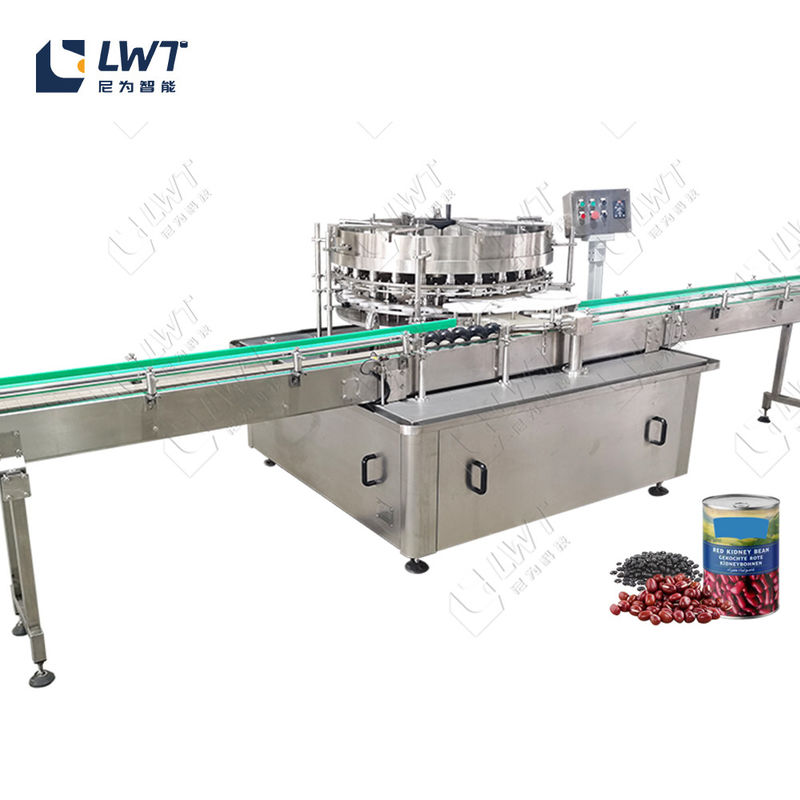
This page covers the LWT rotary filler for diced materials — a stable, fully automatic filling machine built for vegetables, fruits, corn, red beans, mung beans, kidney beans, chickpeas, peas and small diced meat. Filling heads are available in any even number from 2 to 24, so the machine is sized around your output instead of the other way round. Portion size is set by interchangeable volumetric cups and the filling range stays adjustable, so the same machine can run 30–100 g portions on one shift and 200–1000 g portions on the next.
It is most often specified inside a canned food production line, downstream of the vegetable washing machine and upstream of the auto capping machine, the sterilization machine and the automatic labeling machine.
Where Hand Filling Breaks Down
Hand filling works until the line speeds up. It is limited by the human eye and the human wrist, and neither is repeatable at thousands of cans an hour. Three problems show up on almost every line that still fills by hand:
Giveaway cost. Operators over-fill to stay safe on declared weight. On a 400 g can, 10 g of extra product on every can is 2.5% of your raw material — paid on every can, all year, with nothing shipped in return.
Weight complaints. Under-filled cans fail the declared net weight check, while over-filled cans put the label numbers wrong in the other direction. Both end up as rejected batches or customer claims.
Line stop-start. Filling is the slowest manual step on a canning line. Every break, shift change and new operator resets the accuracy curve for the whole line behind it.

Our Solution: Volumetric Measuring Cup Filling
The LWT rotary filler removes the guesswork by measuring product in volumetric measuring cups instead of by eye. Each cup holds a fixed volume, is filled as the turntable rotates through the filling stations, and then discharges into the can or jar. Because the portion is set by the cup and not by the operator, it is identical on the first can and on the ten-thousandth.
Portion control on this machine is mechanical rather than electronic: changing the filling range means changing the measuring cup set, which is why a single platform covers everything from 10–60 g herb and dice portions up to 1000–5000 ml bulk packs. Additional cup sets can be quoted with the machine so your full product range is covered from the first order.
Control comes from Siemens PLC with Schneider electrical components. The product contact structure is built from 2 mm thick "304" stainless steel, and the drive chain runs on hard nylon sprockets — light, quiet and durable, with an open layout that keeps daily cleaning and maintenance short. A screw bottle separating mechanism and a star wheel turntable index each container into position under the filling station, so containers are presented squarely instead of being fed by hand.
Because the portion comes from the cup rather than from the operator, accuracy holds through shift changes, operator turnover and seasonal variation in product size, so declared net weight stays stable long after commissioning rather than only on the acceptance test.
LWT has been building filling and canning equipment since 2009 and now serves customers in more than 100 countries, with projects across Europe, Latin America, the Middle East and Asia. Diced food filling machines of this type are already running on Turkish and Russian canning lines filling diced product into tin cans and glass jars.
Technical Specifications
|
Parameter
|
Specification
|
|
Filling method
|
Volumetric measuring cup dosing with adjustable filling range
|
|
Filling heads
|
2–24 heads, any even number (customizable)
|
|
Filling speed
|
3,000–12,000 BPH (customizable)
|
|
Filling accuracy
|
±0.5%
|
|
Filling range
|
10–60 g / 30–100 g / 50–250 g / 100–500 g / 200–1000 g / 500–2500 ml / 1000–5000 ml (customizable)
|
|
Feeding tray size
|
700–1100 × 120–150 mm (customizable)
|
Machine Components
The filling station is assembled from eight sub-assemblies, each of which can be serviced without dismantling the machine:
1.Feeding tray
2.Measuring cup mechanism
3.Receiving platform
4.Height adjustment unit
5.Filling station
6.Screw bottle separating mechanism
7.Star wheel turntable
8.Electrical control panel
How the Filling Cycle Works
- Prepared diced product is loaded into the feeding tray.
- The measuring cup mechanism fills each cup to its fixed volume as the turntable rotates.
- The screw bottle separating mechanism indexes incoming cans or jars into a single, evenly spaced row.
- The star wheel turntable carries each container to the filling station and holds it square under the cup.
- The height adjustment unit sets the cup-to-container clearance for your container height, so the same machine runs shallow tuna cans and tall glass jars.
- The cup discharges the measured portion into the container, and the filled container leaves the turntable towards the next machine on the line.
Applications
|
Industry
|
Typical Products
|
Packing Format
|
|
Canned vegetable production
|
Diced carrot, corn, peas, diced cucumber
|
Tin cans, glass jars
|
|
Canned bean production
|
Red beans, mung beans, kidney beans, chickpeas, baked beans
|
Tin cans, glass jars
|
|
Canned fruit production
|
Diced peach, pineapple pieces, mixed fruit
|
Tin cans, glass jars
|
|
Canned meat & ready meals
|
Small diced meat, meatballs
|
Tin cans, retort pouches
|
|
Canned pet food
|
Diced meat,Dry pet food,Freeze-dried
|
Tin cans, pouches
|
FAQ
Q: How accurate is the filling weight, and how is it controlled?
A: Portion size is set by the volumetric measuring cup rather than by an operator, and the machine holds about ±0.5% across a run, which is normally well inside the declared net weight tolerance on canned vegetables, beans and diced meat. Where your product needs a tighter figure, we recommend a checkweigher downstream of the filler.
Q: Can one machine run more than one pack size?
A: Yes. The filling range is adjustable and the portion is changed by swapping the measuring cup set, so a single filler covers 10–60 g through 1000–5000 ml. Additional cup sets are quoted with the machine so the whole product range can be planned from the start.
Q: Will it handle our container — glass jars as well as tin cans?
A: Yes. The height adjustment unit sets the cup-to-container clearance for your container height, and the screw and star wheel assembly is matched to your container diameter. Send us your container drawings and the machine will be set up for that container before shipment.
Q: Where is LWT based, and can we visit the factory?
A: LWT is based in Shanghai, China, and has been manufacturing canning, filling and packaging equipment since 2009. Our facility covers the full cycle of R&D, manufacturing and pre-shipment testing, with 25 R&D engineers and 14 patents awarded. Customers are welcome to visit the factory for an on-site acceptance test before delivery, and for buyers who cannot travel we run the same test on a live video call.
Q: What does LWT provide beyond the machine itself?
A: End-to-end support: line layout and solution design, equipment manufacturing, factory testing, installation and commissioning guidance, operator training, remote technical support and spare parts supply. Every LWT filling machine is supplied with a 1-year warranty and free replacement parts, so the line keeps running after commissioning as well as on the day it starts.
Call to Action
Get a filling recommendation for your product. Send us your container size, target fill weight and required cans per hour — our engineers will reply within one working day with the recommended filling range, the matching measuring cup set and a firm quotation.





 Your message must be between 20-3,000 characters!


Overall Rating
Rating Snapshot
The following is the distribution of all ratingsAll Reviews