Automatic Mushroom Canning Production Line: From Fresh Mushroom to a Labeled Tin Can
――――――――――――――――――――――――――――――
Introduction
A mushroom canning production line is not a filling machine with a few conveyors attached — it is a chain of process decisions. Fresh button mushroom is a soft, high-moisture raw material, and every hour it spends between blanching and sealing is an hour in which texture, colour and yield can quietly disappear. This page describes the full line we build around that reality: fifteen machines, one process flow, from the raw mushroom intake on the washing line to the labeled and coded can coming off the end.
The line is dimensioned for 500 kg per hour of fresh mushroom intake and is engineered around round tinplate cans in the two formats that dominate the canned mushroom trade, the 400 g retail can and the 3 kg catering can. Because the pre-treatment, canning, sealing and sterilization stages are selected as one set, the line is supplied as a turnkey canning line rather than as a list of units that a factory has to integrate itself.
What separates one canned mushroom production line from another is rarely the machine count. It is whether the blancher and the cooler are matched to each other, whether the can reaches the filler clean, and whether broth that leaves the soup kitchen is still at temperature when it lands in the can. Those three points drive the design below, and they are the reason a button mushroom canning line from LWT can be handed over with a predictable yield instead of a settling-in period.
Line at a Glance
|
Section
|
Machines in the section
|
What the section does
|
|
Raw material preparation
|
Bubbling cleaning machine, pre-cooker, cooling machine, mushroom slicing machine
|
Washes, blanches, cools and slices fresh button mushroom
|
|
Empty can preparation
|
Can washing machine
|
Cleans and heats empty tinplate cans before filling
|
|
Canning and liquid dosing
|
Manual canning platform, broth filling machine, 300 L soup preparation system
|
Places solid mushroom, then doses hot broth to the target ratio
|
|
Sealing
|
Semi-automatic vacuum can seaming machine
|
Draws vacuum and seams the lid onto the filled can
|
|
Sterilization
|
Two-station sterilizer
|
Cooks and stabilizes the sealed can
|
|
Finishing
|
Semi-automatic labeling machine, ribbon coding machine
|
Labels and codes the finished can
|
|
Plant utilities
|
Steam boiler, soft water processing system, air compressor
|
Supplies steam, treated water and compressed air on site
|
Working Process
- Fresh button mushroom is tipped into the bubbling cleaning machine, where air bubbles and a moving water bath separate soil, straw fragments and grit from the caps and gills.
- The mushroom is blanched in the pre-cooker. Steam enters through a valve-controlled trough, and blanching sets the texture and colour that the finished can will keep.
- The cooling machine brings the product down in temperature immediately, so cooking does not continue while the mushroom waits for the canning station.
- The slicing machine cuts the mushroom to the thickness the recipe calls for, keeping slice-to-slice thickness consistent across the run.
- In parallel, empty tinplate cans pass through the can washing machine, which both washes and heats them, so the filler receives a clean, warm can rather than one at ambient temperature.
- The manual canning platform places the solid mushroom. It runs on two separate lanes — empty cans in one, filled cans in the other — with tables on both sides, so the operator controls how the mushroom sits in the can without ever mixing full and empty containers.
- The broth filling machine tops the can up with hot broth drawn from an insulated circulating buffer tank, which is what holds the 60% solid / 40% liquid ratio steady can after can.
- The semi-automatic vacuum can seaming machine pulls vacuum and closes the can, the step that determines how long the finished product will keep.
- The two-station sterilizer runs heating, holding and pressure automatically once the program is started, so the cook is repeatable instead of dependent on who is on shift.
- The labeling and coding station applies the self-adhesive label and prints the batch and date code, after which the can is ready for packing and storage.

Engineering Details That Decide Yield
A matched blancher-and-cooler pair. Blanching temperature and cooling length are selected together, which is what stops the soft mushroom from over-softening between the two stages.
A heated wash, not a rinse. The can washer is a single-stage washer with heating and automatic temperature control, and it accepts both the 3 kg 15173 can and the 400 g 7113 can, so one machine covers a two-format programme.
A closed hot circuit for broth. Two steam-heated 300 L stirring tanks, transfer pumps and piping feed an insulated buffer tank on the filler, so the broth arrives at the dosing head at the temperature it left the soup kitchen.
Material chosen for brine, not for appearance. Everything that contacts the broth — tank internals and the filling circuit — is #316 stainless steel, while frames and panels use #304. Salt and mild acidity attack 304 contact faces over time, and 316 removes that failure mode where it actually occurs.
Vacuum sealing kept simple and serviceable. A semi-automatic seamer with an integrated vacuum pump system is easier to set, verify and maintain on a line of this size than a fully automatic seamer that has to be rebuilt for every can diameter.
Utilities engineered with the line. Boiler, soft water system and air compressor are sized against the actual steam, water and air demand of this machine set, so a plant does not end up buying utility capacity twice.
Applications Beyond Button Mushroom
The pre-treatment section is the mushroom-specific part of the line, while the canning, sealing, sterilization and finishing stages form a deliberately product-agnostic block. That split lets one investment serve more than one canned product family.
Mushroom family. Button mushroom whole or sliced, straw mushroom, and the cultivated mushrooms that behave similarly in a blancher — oyster mushroom, king oyster mushroom, shiitake and enoki — all run on the same washing, blanching and slicing sequence with different slice settings.
Canned vegetables in brine. Sweet corn, green beans, mixed vegetables and bamboo shoot run on the same core line; only the blancher timing and the cutting head change, and the can washing, dosing, sealing and sterilization stages stay exactly as they are. Factories that plan this from the start can size the line so that it later serves as a canned food line for a whole vegetable programme.
Canned beans and pulses. Baked beans, kidney beans and chickpeas use the same dosing and sterilization modules with a sauce or brine recipe instead of mushroom broth, which is where a broth circuit built around an insulated buffer tank pays for itself a second time.
Canned fruit in syrup. Peach halves, pineapple and fruit cocktail are packed on the same platform when syrup dosing replaces broth dosing, with the canning platform handling the fruit by hand exactly as it handles mushroom.
If you already run other canned food lines, the same utilities and the same finishing equipment can be shared between them — which is why we quote the line as canned food processing equipment for a plant rather than as an isolated machine set.
Customization and Project Services
Four variables drive every project: can diameter, can height, solid-to-liquid ratio and the filling liquid — brine or syrup — together with its viscosity. The pre-treatment section is then sized from the raw material you actually buy — fresh mushroom, pre-blanched mushroom, or frozen slices behave differently in a blancher.
The project scope covers layout drawing and utility schedule, factory testing of the individual machines, an installation and commissioning package, operator training, a wear-parts list for the washing, filling and seaming stations, and an English-language PLC interface. Where a customer intends to add a second product family later, we can pre-arrange the line for that expansion at the design stage instead of retrofitting it afterwards.
Company Profile
Shanghai LWT Intelligent Technology Co., Ltd. designs and builds canning, filling and packaging lines for food factories and supplies them as complete turnkey projects rather than single units. Our engineers work from the customer's product specification, can drawing and plant layout, and stay involved from the layout drawing through commissioning. Mushroom, vegetable, bean, fruit, meat and seafood canning all sit within our regular scope.
Contact
Send us your can drawing, target output per shift, raw material form and available plant utilities, and we will return a machine list, a layout and a budget range for a line sized to your product. Click here to get the best price and a free line proposal— a real proposal from an engineer, not a catalogue page.
――――――――――――――――――――――――――――――
Technical Specifications
|
Parameter
|
Specification
|
|
Can type
|
Tinplate round can (customizable)
|
|
Can sizes
|
400 g (Ø73 × 113 mm) and 3 kg (Ø155 × 173 mm)
|
|
Solid-to-liquid ratio
|
60% solid / 40% liquid (customizable)
|
|
Pre-treatment
|
Bubbling washing, steam blanching, cooling and slicing
|
|
Can washing
|
Single-stage washing with heating and automatic temperature control
|
|
Broth circuit
|
2 × 300 L steam-heated stirring tanks with insulated buffer tank
|
|
Sealing
|
Semi-automatic vacuum can seaming with vacuum pump system
|
|
Sterilization
|
Two-station sterilizer, automatic heating, holding and pressure control
|
|
Utilities included
|
Steam boiler, soft water processing system, air compressor
|
|
Power supply
|
220 V / 380 V, 50 Hz
|





 Your message must be between 20-3,000 characters!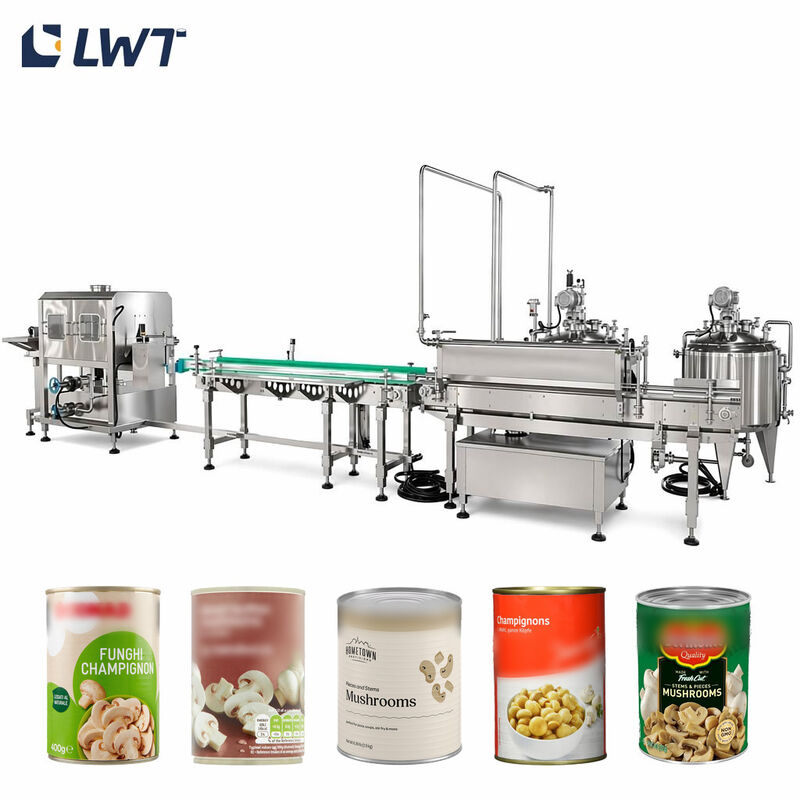


Overall Rating
Rating Snapshot
The following is the distribution of all ratingsAll Reviews